
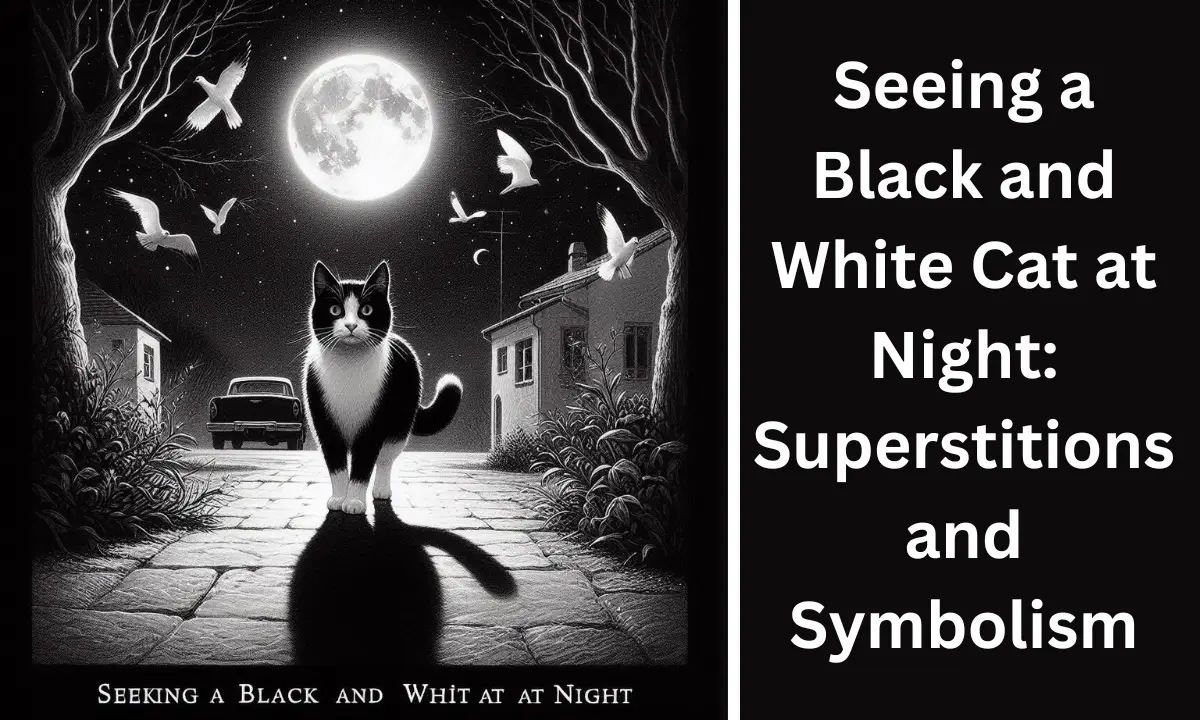
The night air is crisper when the moon is high and incandescing its silvery light upon the world. A night like this — when one may reflect, wander, or seek solitude — often comes with unexpected encounters, each capable of poetic interpretation. Among these unexpected meetings is the peculiar yet charming sighting of a black and white cat. This enigmatic creature, juxtaposed against the blackness or shadows of the nocturnal world, beckons the observer to a crossroads of superstitions and symbolism.
Superstitions Surrounding Black and White Cats
If a dark alley harbors a black and white feline, be prepared for the children’s rhymes and folklore warnings to flood your mind with misgivings. “Don’t pass a black and white cat at night;” “One black, one white, take great care,” these words whisper caution. But why?
Assumptions of Misfortune:
Black cats, often associated with witches and evil omens, elicit fear in many cultures. Their white counterparts, symbols of purity and goodness, stand in stark contrast. However, black and white cats present a paradox that beckons one to question the rigid classifications of ‘good’ and ‘bad.’
The Shift in Perspectives:
Tales of black cats and dark curses find their origins in a complex tapestry of historical events and the narratives spun from them. The Middle Ages’ witch hunts and persecution have colored our perception of these creatures. Yet, there are those who hold them in high regard, considering them as positive omens. The dichotomous nature of society’s opinion on black and white cats reflects not only the superstitions but also a powerful human tendency to dichotomize choices, individuals, and the unknown.
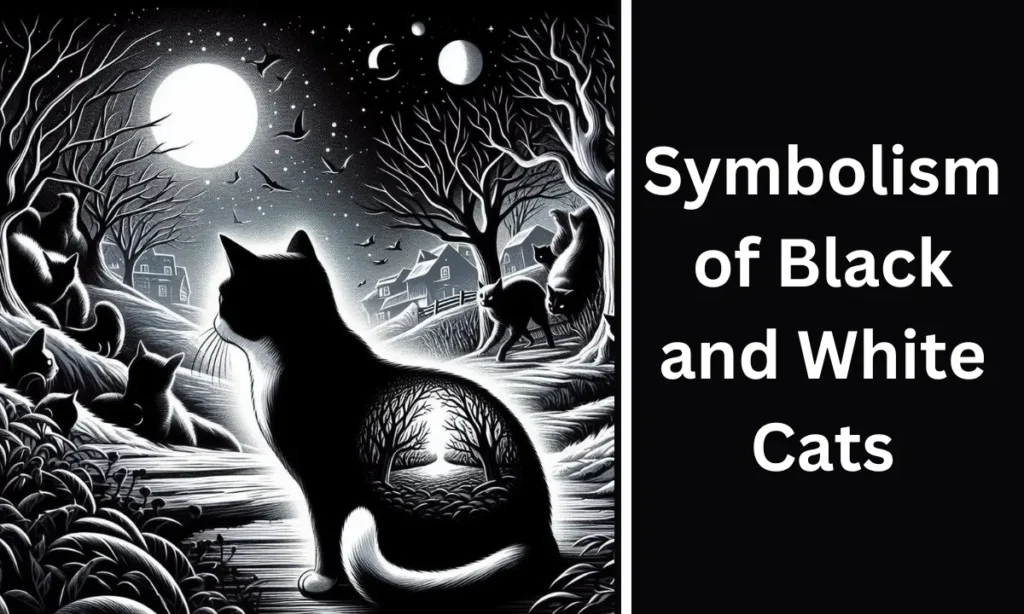
Symbolism of Black and White Cats
The famous yin-yang symbol of Daoism speaks to the interplay of elements, suggesting that opposing forces are complementary and interdependent. This balance is embodied by the image of a black and white cat under the moonlit night.
Yin and Yang
The rich symbolism of yin and yang is particularly resonant with the duality of black and white, of chaos and order, and the natural fluctuation between extremes. At the same time, the black spots in white and white in black evoke elements of the opposite, challenging us to view the world as a tapestry of grays rather than stark monochrome.
A Reminder of Balance
Nature’s canvas regularly showcases the harmonious mix of black and white, of night and day. It attests to the cyclical ebb and flow, where one cannot exist without the other. In this regard, the encounter with a black and white cat at night may well serve as a reminder of the equilibrium that we, too, must seek in our lives.
Personal Reflections
The path of personal reflection is one of subjectivity, a realm where individual interpretation reigns supreme. My own encounter with a black and white cat at a late hour has left a profound impression, not of fear but of beauty and mystery.
Interpretation of the Encounter
The cat, silent and unfazed by the encroachment of the urban night, exuded a presence that transcended the implications of its fur. It seemed to regard me momentarily, with eyes that held more questions than answers, before continuing on its way. This solitary exchange, devoid of language yet rich in nonverbal communication, left me contemplating the unspoken wisdom of the nocturnal world.
Beliefs on Superstitions and Symbolism
While I appreciate the depth and history behind superstitions, I find myself reluctant to assign labels of luck or doom to such encounters. The fluidity of symbolism and the cultural baggage accompanying it often oversimplify the richness of our experiences. I am guided instead by the conviction that understanding arises from a nuanced appreciation of the world, not from the convenience of superstitions.
Challenging Perceptions
In the calm amid the brushfire of human tradition and convention lies the challenge of critical thought. Challenging these beliefs, however, embedded, encourages a landscape ripe for genuine discovery and understanding.
Questioning Superstitions
For every black and white cat that crosses a path, countless others do not. The selective reinforcement of beliefs through the assumption of causality often leads to false positives and misattributions. One must be cautious to not assign disproportionate weight to superstitions, especially when it involves the treatment of beings — human or otherwise — based on perceived signs and symbols.
Encouraging Open-Mindedness
The valorous endeavor against superstition is not a call to abandon all tradition, but a plea for balance. It is an acknowledgment of the richness of the human experience, where logic and wonder can coexist. Encounters with black and white cats at night, if anything, call for open-minded interpretations that celebrate diversity and curiosity over fear and ignorance.
Cultivating Critical Thinking
The path to critical thinking is neither linear nor easy, often leading to philosophical discomfort. It demands that we grapple with the unknown, challenging both inherited beliefs and paradigms. To think critically is not merely to possess knowledge but to continually question and engage with it, fostering a society that is not beholden to the trappings of superstitions.
Conclusion
The encounter with a black and white cat at night is a tableau that we have embellished with layers of superstitions and symbolism. It stands as a testament to our need to make sense of a world that often defies easy categorization. While my reflections may differ from those who uphold these traditional beliefs, the profound opportunity for discourse and self-exploration is apparent.
In this, I propose a different approach, one that does not dismiss superstitions outright but questions their merits and implications. By doing so, we cultivate a society that is both rooted in its history and open to the mysteries that each nocturnal stroll offers. For ultimately, it is the collective weave of our narratives, and the malleability to reexamine, that defines our human experience with the world and its inhabitants – dark or light, day or night.